
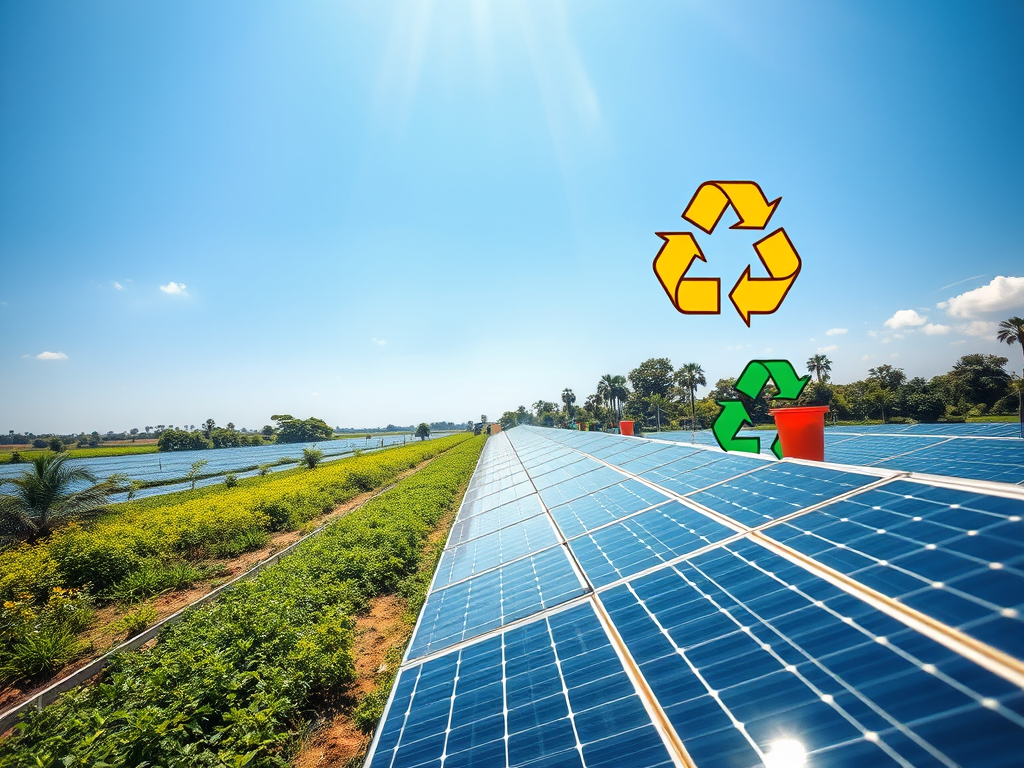
♻️Background: A Growing Environmental Challenge
On May 30, 2025, the Central Pollution Control Board (CPCB) released draft guidelines on “Safe Handling and Disposal of Solar Photovoltaic Modules, Panels, and Cells” under the E‑Waste (Management) Rules, 2022 (Ref-1, Ref-2).
With India’s PV capacity soaring past 73 GW by March 2023, solar module waste is forecast to hit 34,600 tonnes by 2030, and surge to 600,000 tonnes by 2040. (Ref)
These guidelines assign legal responsibility—via Extended Producer Responsibility (EPR)—to panel manufacturers, importers, and bulk consumers. They must ensure modules are returned to approved dismantlers or recyclers and submit concise annual reports on waste volumes (Ref).
This marks a defining step toward formalising India’s solar recycling sector.
🔧Why This Matters: Carbon, Circularity & Profit
Solar panels contain valuable materials—glass, aluminium, silicon, copper, silver, and even toxic heavy metals like lead or cadmium. If not processed properly, they pose serious environmental and health hazards (Ref).
Recycling reduces:
- Carbon footprint from new material extraction
- Long‑term pollution from unsafe dumping
- Dependency on imports of precious metals
The CPCB guidelines promote collection systems, recycling targets, capacity-building, and dedicated infrastructure.
They also encourage R&D in advanced recovery technologies, offering a potential competitive edge to early movers (Ref-1, Ref-2).
From an investment perspective, this translates to a win-win scenario for long-term investors (who can keep their urge for quick money aside) through
- Tangible ecological benefits and
- Long-term value from an evolving circular economy, driven by both compliance and resource optimisation.
💹 Spotlight on Listed Indian Recycling Players
The following two stocks are taken up as a reference for providing better understanding and not as investment advice. The approach used can be adopted for other smaller players and new players who will enter the fray in the coming years
The following two publicly listed companies stand out in India’s formal recycling segment that can offer insights for investors focused on sustainability and EPR-driven growth:
Eco Recycling Ltd
- Market Cap: ₹1,167 crore
- Price/Earnings (P/E): ~49.9x
- Price/Book Value: ~13.3x
- 52‑Week High/Low: ₹1,215 / ₹502
- EPS & PAT Growth: Profit ₹23.4 cr on revenue ₹44 cr; delivering ~73% CAGR in profit over five years (Ref: screener.in).
Comment: The stock, despite declining ~37% this year, is still very expensive. A more meaningful correction(of 20-30% at least) is needed to see a good entry point for long-term investors.
Organic Recycling Systems Ltd (ORS)
- Market Cap: ₹217 crore [Between Micro and SmallCap]
- Price/Earnings (P/E): ~13.8x
- Price/Book Value: ~1.6x
- EPS (TTM): ₹18.70 (Basic ₹20.39) [Based on June 2025 Data] (Ref: Dalal Street Investment Journal)
- Profit After Tax (FY25): ₹15.72 cr (up 102% YoY) [Based on June 2025 Data]
- Sales FY25: ₹48.73 cr (75% YoY)
- PAT Margin FY25: 32.25% (a 429-bps increase) (Ref: Dalal Street Investment Journal)
Comment: The stock, having declining ~27% this year and having low PE & PB may seem attractive but we need to see few other things – Promoter holding has reduced, Liabilities have been increasing, FIIs have stayed away, DIIs have nominal presence and low-liquidity(as total outstanding shares ~70 Lakhs or 7Million)
📈Investing Implications
| Aspect | Why It Matters |
|---|---|
| High Valuations | Reflect strong earnings growth and future prospects, but require monitoring for long-term sustainability |
| Theme Exposure | Investments in Eco Recycling and ORS offer direct exposure to India’s national push on solar PV waste recycling |
| Growth Potential | With CPCB’s push and global climate targets, demand for recycling tech and capacity will rise |
| Risk Factors | Valuations may compress; reliance on policy execution and infrastructure build-out |
✅Investing in the Recycling Ecosystem: Considerations
- Regulatory momentum – CPCB guidelines and EPR enforcement finalisation could trigger capacity expansions.
- Infrastructure execution – Effectiveness depends on whether collection and recycling channels scale up efficiently, reducing reliance on informal dismantling.
- Technology leadership – Companies innovating in chemical/thermal recovery of scarce solar materials (silver, rare earths) may gain a competitive advantage.
- Valuation discipline – Stocks with high P/E or P/B ratios must consistently grow earnings to justify premiums. (Valuation Trap!!)
🧭Final Takeaway
As India accelerates towards a 292 GW solar capacity by 2030, the 600,000 tonnes of PV waste projected by 2040 will demand urgent attention (Ref-1, Ref-2, Ref-3).
This exponential rise in the PV waste creates a multi-billion‑dollar opportunity across the recycling value chain—from collection, processing, and material recovery, to industrial R&D and institutional EPR compliance.
For ESG-aligned investors, companies like Eco Recycling and ORS offer a compelling story for entering into this high-growth, sustainability-linked sector – if the price point is apt.
While elevated valuations reflect optimism(and also caution), ongoing regulatory follow-through and operational scale-up will be key to unlocking long-term value and contributing to India’s carbon-neutral goals.
 Lateral Thinking
Leave a comment