

Introduction
A CMOS backplane is the active “driving” substrate found behind modern flat-panel and microdisplay technologies. Built using standard Complementary Metal-Oxide-Semiconductor (CMOS) processes, it contains the tiny transistors, capacitors, and interconnects that switch each pixel or sensor element on and off.
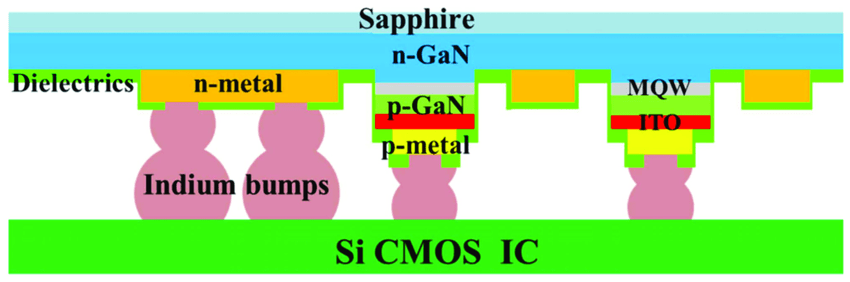
Here is a concise look at what it does, where it is used, and the hurdles designers face when integrating it into finished products.
What Is a CMOS Backplane?
- Active Matrix Driver: Each pixel (or sensing element) is paired with one or more CMOS transistors that control its on/off state or readout.
- Built on CMOS Wafer: Leverages mature silicon-fab processes, enabling tight transistor density, low power, and high reliability
- Versatile Interface: Provides digital or analog signals to downstream layers—whether an OLED emissive stack, microLED chips, or photodiodes
Key Applications
- Flat-Panel Displays (OLED, LCD, MicroLED)
- High-resolution televisions, monitors, smartphones, and tablets
- Wearable displays and head-mounted AR/VR optics
- Imaging Sensors & Machine Vision
- CMOS image sensors in digital cameras and smartphones
- LIDAR arrays and IR sensors for automotive and industrial use
- Microdisplays & Near-Eye Systems
- AR glasses, VR headsets, and viewfinders for cameras
- Helmet-mounted displays in aviation and defence
- Fingerprint & Biometric Sensors
- Under-display fingerprint readers in smartphones
- Medical diagnostics chips for lab-on-a-chip systems
Integration Challenges
- Material Compatibility:
- High-temperature CMOS processes vs. temperature-sensitive OLED or microLED materials
- Stress mismatches can cause layer delamination or pixel defects
- Yield & Defect Management:
- Millions of transistors per backplane—each defect can knock out an entire pixel
- Rigorous testing and redundancy schemes add cost and complexity
- Fine-Pitch Interconnects:
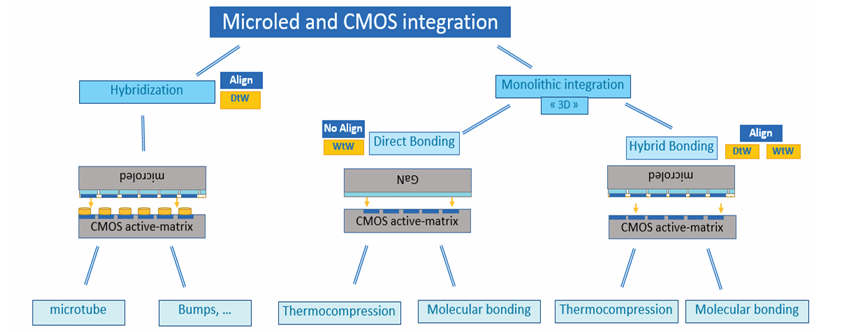
- MicroLED or OLED pixels must align to CMOS pads with micron-level accuracy
- Flip-chip bonding or micro-transfer printing demands precise alignment and uniform pressure
- Thermal & Power Constraints:
- Dense transistor arrays generate heat, and limited thermal conductivity through stacked layers
- Need for low-power drive schemes to avoid uneven heating (which degrades lifetime)
- Scaling to Higher Resolutions:
- Smaller pixels require thinner gate oxides and tighter lithography, pushing CMOS fabs to their limits
- Increased data rates for video drive higher-speed drivers, raising electromagnetic-compatibility concerns
Looking Ahead
Advances in heterogeneous integration—such as wafer-scale microLED transfer, advanced packaging, and flexible CMOS processes—are steadily addressing these challenges.
As backplane technologies mature, we can expect even sharper, brighter, more power-efficient displays and sensors in everything from our smartphones to our cars and beyond.
Summary
The CMOS backplane is the unsung hero behind today’s high-resolution displays and sensors. While integrating silicon-based drivers with delicate emissive or sensing materials poses real engineering hurdles, ongoing innovations in process integration and packaging are unlocking ever more impressive visual and imaging capabilities.
 Lateral Thinking
Leave a comment