Definition
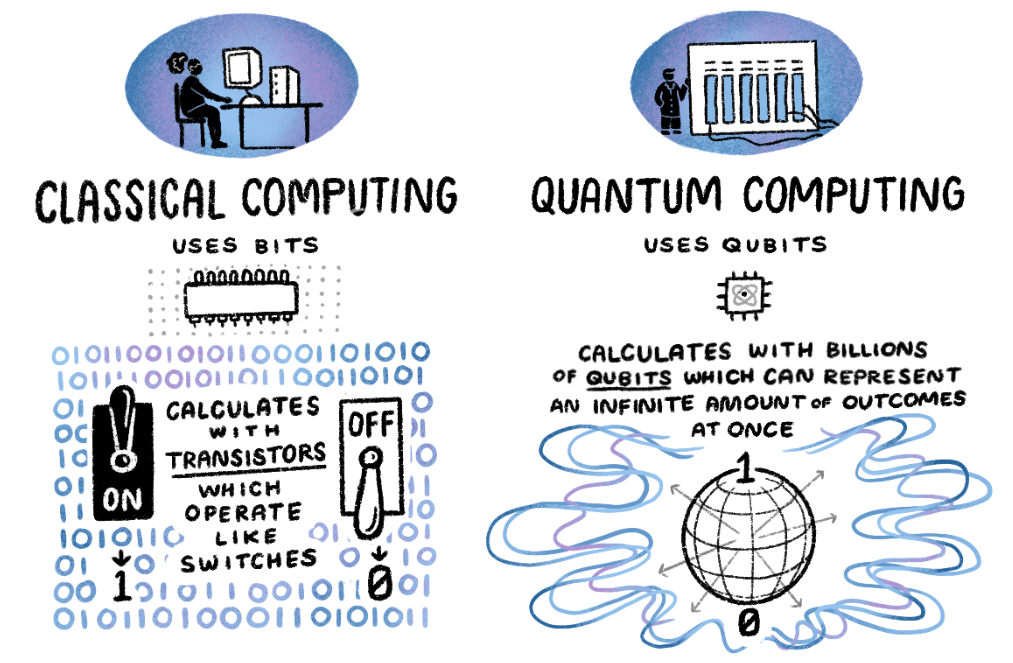
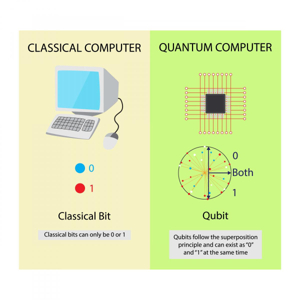
A quantum computer is a device that performs computations by manipulating quantum states of qubits—quantum bits—which, unlike classical bits, can exist in a superposition of 0 and 1 at the same time.
This unique property and entanglement enable quantum computers to solve certain complex problems much faster than classical computers.
Materials Used in Quantum Computers
Different physical systems and materials are used to realise qubits in quantum computers.
Here are the primary materials and how they are used:
- Superconducting Materials
Superconductors, such as aluminium or niobium, are used to create superconducting qubits. At ultralow temperatures (close to absolute zero), these materials exhibit zero electrical resistance, allowing electrons to pair up (forming Cooper pairs) and tunnel through insulators via Josephson junctions. This setup is central to the operation of superconducting quantum processors, which are among the most widely used in current quantum computers. - Trapped Ions
Individual atoms (often ytterbium or calcium ions) are trapped using electromagnetic fields in a vacuum. Laser pulses are used to manipulate the quantum state of these ions, making them act as qubits. The high degree of control and long coherence times make trapped ions a promising platform. - Photonic Systems
Photons (particles of light) are used as qubits, typically manipulated using optical circuits and materials like silicon or other transparent media. Photonic quantum computers leverage the quantum properties of light for computation and communication - Semiconductors
Quantum dots or impurities in silicon or diamond (such as nitrogen-vacancy centres in diamond) can trap single electrons or holes, whose spin or charge states serve as qubits. These systems benefit from established semiconductor fabrication techniques. - Topological Materials
Still largely experimental, these materials aim to create qubits that are inherently protected from certain types of errors by the material’s topological properties, potentially enabling more robust quantum computation
How Are Materials Used?
Each material system provides a different way to physically realise, control, and read out qubits:
- Superconductors and Josephson junctions are patterned into circuits on chips, cooled to near absolute zero, and controlled with microwave pulses
- Trapped ions are held in place and manipulated with lasers in ultra-high vacuum chambers
- Photonic systems use waveguides and beam splitters to guide and process photons as qubits
- Semiconductor-based qubits are fabricated using nanotechnology to isolate and control individual quantum states
These diverse material approaches aim to achieve stable, scalable, and controllable qubits—the foundation for building practical quantum computers.
References:
- https://www.quantum-inspire.com/kbase/introduction-to-quantum-computing/
- https://www.ibm.com/think/topics/quantum-computing
- https://www.investopedia.com/terms/q/quantum-computing.asp
- https://aws.amazon.com/what-is/quantum-computing/
- https://en.wikipedia.org/wiki/Quantum_computing
- https://www.qureca.com/resources/article/quantum-computing-for-dummies/
- https://azure.microsoft.com/en-us/resources/cloud-computing-dictionary/what-is-quantum-computing
- https://www.bluequbit.io/quantum-computing-basics
 Lateral Thinking
Leave a comment