
Introduction
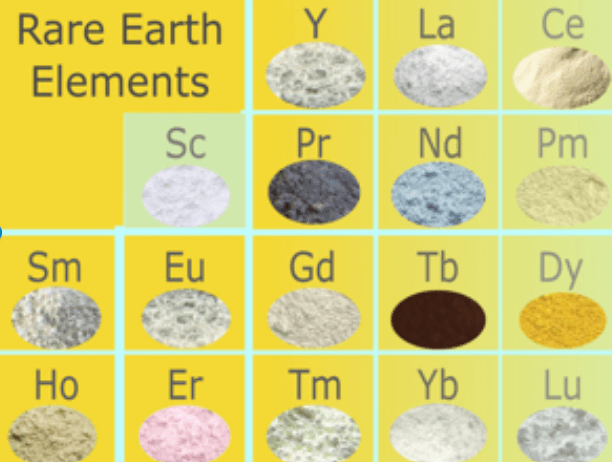
Rare earth minerals—also known as rare earth elements (REEs)—are a group of 17 special metals found in the Earth’s crust. Despite the name, they aren’t actually rare. The confusion comes from how difficult and expensive it is to mine and separate them from the rocks and minerals where they are found.
These elements are crucial for many of the technologies we use every day, especially in electronics and green energy.
Different Types of Rare Earth Elements
Rare earth elements are made up of two main groups:
- The Lanthanides: These are 15 elements, from lanthanum (La, atomic number 57) to lutetium (Lu, atomic number 71)
- Scandium and Yttrium: These two are not lanthanides, but they are usually included with them because they are found in the same kinds of ores and have similar properties
Here is a quick look at some of the most important rare earth elements and what they are used for:
| Element | Symbol | Applications |
|---|---|---|
| Neodymium | Nd | Powerful magnets for motors, headphones, wind turbines, and electric vehicles |
| Dysprosium | Dy | Used with neodymium for high-temperature magnets in EVs and wind turbines |
| Lanthanum | La | Camera lenses, rechargeable batteries, glass for screens |
| Europium | Eu | Red phosphors for LED and TV screens |
| Terbium | Tb | Green phosphors for screens and lighting |
| Yttrium | Y | Lasers, camera lenses, superconductors, and energy-efficient lighting |
| Cerium | Ce | Polishing powders, catalytic converters, self-cleaning ovens |
How Rare Earth Elements Shape the Digital Age
Rare earth elements are the unsung heroes of the digital world.
Almost every electronic device you own—your smartphone, laptop, TV, and even your car—depends on them.
Consumer Electronics
- Smartphones and Tablets: Neodymium is used in tiny, super-strong magnets for speakers and vibration motors. Lanthanum improves camera lens quality, and europium and terbium help create the bright colours on your screen
- Laptops and Computers: Rare earths like lanthanum and cerium make data storage in hard drives more efficient. Erbium is used in semiconductors to boost processing power
- Monitors and TVs: Europium and terbium are used in phosphors to create vivid red, green, and blue colours on LED and LCD screens
Green Technology
- Wind Turbines: Neodymium magnets are essential for the generators in wind turbines, making renewable energy possible
- Electric Vehicles (EVs): Neodymium and dysprosium magnets are used in the motors of EVs, making them more efficient and powerful
- Rechargeable Batteries: Lanthanum is used in some types of rechargeable batteries, and rare earths are key to improving battery performance
Everyday Life
Rare earth elements are also found in:
- LED and Fluorescent Lights: Yttrium, europium, and terbium help make lights brighter and more energy-efficient
- Catalytic Converters: Cerium helps reduce car emissions
- Defence and Aerospace: Rare earths are used in everything from radar systems to jet engines
Why Are Rare Earth Elements So Important?
Rare earth elements have unique magnetic, luminescent, and catalytic properties that make them almost impossible to replace in many high-tech applications. They help make devices smaller, lighter, and more powerful.
Without them, modern technology—from smartphones to renewable energy systems—simply wouldn’t work as well or might not even exist.
Challenges and the Future
While rare earths are essential, mining and refining them is difficult and can harm the environment. Most of the world’s supply comes from China, which raises concerns about supply security for other countries.
There is a growing push to find new sources and to recycle rare earths from old electronics to make our use of these critical materials more sustainable.
Summary:
Rare earth minerals are a group of 17 metals vital for today’s technology and green energy. They power everything from your smartphone to wind turbines and electric cars.
Understanding their importance helps us appreciate how much our digital world depends on these hidden but essential elements.
References:
- https://en.wikipedia.org/wiki/Rare-earth_element
- https://www.usgs.gov/centers/national-minerals-information-center/rare-earths-statistics-and-information
- https://natural-resources.canada.ca/minerals-mining/mining-data-statistics-analysis/minerals-metals-facts/rare-earth-elements-facts
- https://www.anavo.com/learn/the-increasing-demand-for-rare-earth-elements/
- https://www.greenteksolutionsllc.com/blog/how-rare-earth-metals-are-used-in-electronics
- https://www.sciencenews.org/article/rare-earth-elements-properties-technology
- https://lynasrareearths.com/about-us/what-are-rare-earths/
- https://www.societybyte.swiss/en/2025/01/31/the-impacts-of-rare-earth-mining-for-our-digital-world-on-biodiversity/
- https://profession.americangeosciences.org/society/intersections/faq/what-are-rare-earth-elements-and-why-are-they-important/
- https://www.americanelements.com/web/rare-earths.html
- https://www.metal.com/en/newscontent/103259776
- https://en.wikipedia.org/wiki/Rare-earth_mineral
- https://www.snexplores.org/article/rare-earth-elements-electrons-properties-technology
- https://nora.nerc.ac.uk/id/eprint/12583/1/Rare_Earth_Elements_profile.pdf
- https://www.ameslab.gov/news/science-news-how-rare-earth-elements-hidden-properties-make-modern-technology-possible
- https://www.startmotionmedia.com/why-rare-earth-metals-are-crucial-for-modern-technology/
- https://georgiatoday.ge/the-economy-of-rare-earth-elements/
- https://www.britannica.com/science/rare-earth-element
- https://www.sciencehistory.org/education/classroom-activities/role-playing-games/case-of-rare-earth-elements/history-future/
- https://www.usgs.gov/media/images/potential-uses-rare-earth-elements-found-marine-minerals
- https://www.afcea.org/signal-media/technology/rare-earths-strategic-minerals-and-chips
- https://web.mit.edu/12.000/www/m2016/finalwebsite/elements/ree.html
- https://www.thomasnet.com/insights/rare-earth-supply-chain/
- https://www.stanfordmaterials.com/rare-earths-in-electronics.html
- https://www.xometry.com/resources/materials/rare-earth-metals/
- https://energy.virginia.gov/geology/REE.shtml
- https://rareearths.com
 Lateral Thinking
Leave a comment