
Introduction
Solar panels on a rooftop have typical service lives of around 25–30 years. After that period, they stop generating enough power and must be decommissioned, entering what is called end-of-life (EOL). An EOL solar panel is simply one that has reached the end of its useful life and is being discarded or replaced. With solar capacity booming, EOL panels are becoming a growing waste stream.
By 2030, the U.S. EPA estimates roughly 1 million tons of solar-panel waste in the U.S. In India, existing installations (≈66.7 GW) had already generated about 100,000 tons of PV waste by 2024, rising to ~600,000 tons by 2030. Globally, studies project tens of millions of tons of PV waste by mid-century. These figures underscore that large-scale panel retirements are on the horizon.
Environmental and Health Concerns
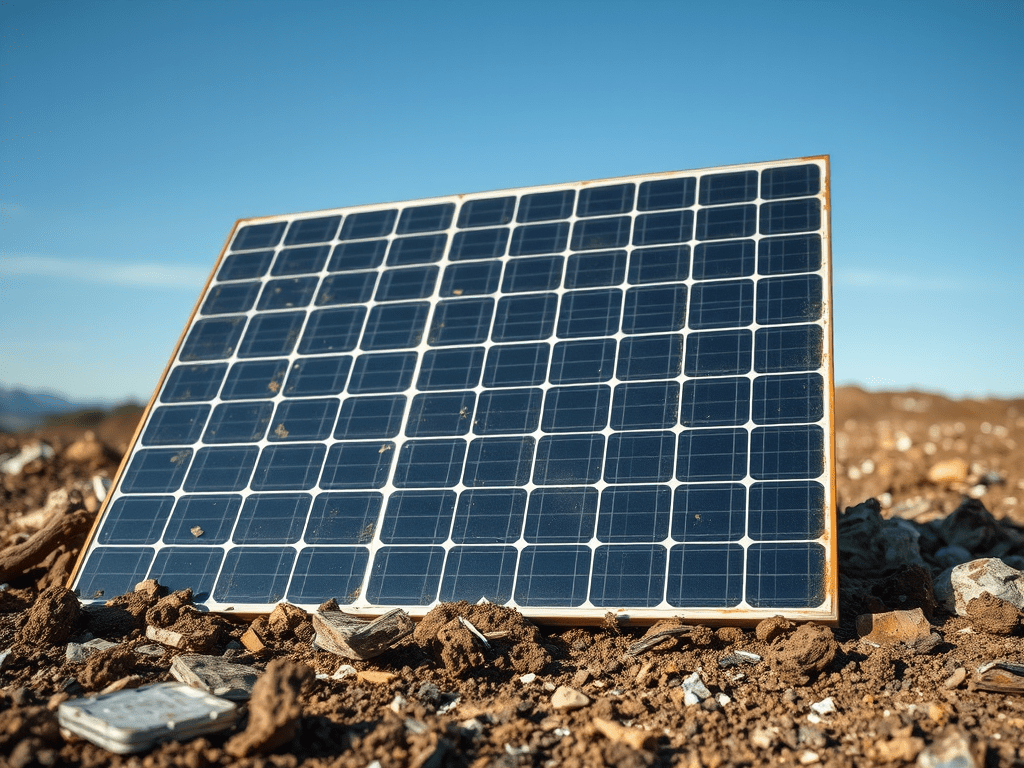
Large solar arrays like this one generate clean electricity for decades, but eventually their panels become waste. Discarded PV modules pose environmental concerns because of their materials.
A typical crystalline-silicon module is roughly by weight
- 76% glass
- 10% polymer plastic
- 8% aluminum
- 5% silicon, and
- 1% copper (with <0.1% silver and other metals)
The bulk of this (glass, plastic, aluminium) is inert, but panels also contain small amounts of metals and semiconductors that can be hazardous.
For instance, solder joints often use lead, and some older/ thin-film panels use cadmium (CdTe cells) – both toxic heavy metals.
If panels are broken or landfilled, rainwater can leach these metals into the soil and groundwater. Indeed, EPA testing shows panels with high lead or cadmium can fail leaching tests and qualify as hazardous waste. In short, end-of-life PV waste can release harmful substances (lead, cadmium, etc.) if not properly managed.
Key hazardous components in PV waste include:
- Lead and Cadmium: Present in solder and thin-film cells. Lead can leach from dumped panels, and cadmium (in CdTe modules) is highly toxic
- Silver and Copper: Valuable metals in cells and wiring. They are not highly toxic, but represent a large resource loss if landfilled
- Glass, Plastic, Aluminium: These make up ~80–90% of panel mass. They are relatively inert, but their sheer volume of waste is large
Improper disposal risks contaminating the environment. Industry reports suggest most retired US panels (~90%) currently go to landfills because it’s cheaper than recycling. This “buries” the problem – and any embedded heavy metals – under inches of soil, which is unsustainable.
The Growing Waste Challenge (US & India Statistics)
As more PV capacity comes online, EOL waste will surge. By 2050, forecasts suggest the US could have 10 million tons of retired panels.
India’s solar waste is expected to grow even faster: installed capacity jumped from 4 GW in 2015 to 73 GW by 2023, and by 2050 India may see ~19 million tons of PV waste.
- United States: ~1 million tons of PV waste by 2030; ~10 million by 2050.
- India: Current PV capacity (~67 GW) produced ≈100,000 tons of waste by 2024, rising to ~600,000 tons by 2030. (This includes roughly 10,000 tons of silicon and tens of tons of silver, cadmium, and tellurium in the waste stream.)
- Worldwide: By 2050, global PV waste could reach ~78 million tons.
These numbers highlight the urgency: without recycling or proper handling, vast amounts of toxic and valuable materials could overwhelm waste systems in the coming decades.
Recycling Benefits: Materials & Circular Economy
Proper recycling of EOL panels turns this waste challenge into a materials opportunity. Advanced recycling can recover the majority of a panel’s components, feeding them back into the economy. In practice, recyclers strip off the aluminum frames and junction boxes, and separate the glass, silicon cells, and metals. Most facilities can already reclaim bulk materials: glass and aluminum (which together exceed 80% of panel weight) and copper wiring. More advanced processes recover silicon, silver, indium, and other semiconductor materials.
Recycling yields multiple benefits:
- Material Recovery: Valuable substances like glass, aluminum, silicon, copper and even silver/tellurium are saved. In fact, silver, silicon and copper (though a small fraction of weight) make up roughly two-thirds of a panel’s material value. For example, India’s projected 2030 PV waste (~600,000 tons) contains about 10,000 tons of silicon and ~12–18 tons of silver. Recycling means reusing these rather than mining new.
- Reduced Mining and Imports: Reprocessing EOL materials cuts the demand for virgin mining. This is especially important for countries like India that import many critical minerals. Recovering domestic solar waste could improve mineral security and reduce import dependency.
- Circular Economy: Recovered materials feed back into manufacturing. Glass and silicon can be refined for new modules, and metals for new conductors. This closed-loop approach aligns with the ideals of renewable energy and the circular economy. Industry analysts note that recycling supports the “circular solar” by keeping materials in use instead of landfilling them.
In practice, recycling is often much less costly environmentally. One study found that reusing recovered PV materials in new production could cut the environmental impacts of new-panel manufacturing by up to ~70%. Recycling also avoids the waste of nearly 60% of the glass, aluminum, and plastics in each panel, keeping them in circulation.
Reducing Carbon Footprint
Recycling end-of-life panels not only saves materials but also lowers carbon emissions. Manufacturing solar panels is energy-intensive (silicon production, glass-making, etc.). Using recycled inputs requires far less energy than extracting and refining new raw materials.
For example, recycling aluminum (used in panel frames) uses about 95% less energy than producing new aluminum from bauxite ore. Similarly, glass cullet from panels can replace furnace-made glass, and recovered silicon bypasses the energy-hungry purification of virgin silicon.
Quantitatively, recycling is a climate win:
- Recycling one ton of PV panels can prevent roughly 1,200 pounds (~545 kg) of CO₂ emissions compared to making the same materials from scratch
- Another study (using life-cycle analysis) found that incorporating recycled materials in panel production yielded ~70% lower carbon impact than a landfill-and-mine scenario. At the panel scale, a solar recycler reports that each panel recycled avoids about 97 pounds (44 kg) of CO₂, rising to ~1.5 tons if a still-working panel is reused. Over millions of panels, those savings add up
In short, recycling shrinks the carbon footprint of solar power further: we generate clean electricity without wasting the emissions “invested” in the panels themselves. By reducing the need for new mining and processing, recycled panels make solar installations even greener.
Conclusion
End-of-life solar panels pose both a challenge and an opportunity. Left unmanaged, they contribute to e-waste streams with hazardous elements. But through responsible recycling, the industry can recover valuable materials, support a true circular economy, and cut greenhouse gases. Experts now emphasize preparing infrastructure and policies (in both the US and India) to handle retired panels.
By doing so, the solar industry can ensure that its legacy remains clean and sustainable well beyond the panels lifespan of 25–30 year.
 Lateral Thinking
Leave a comment