
Introduction
For decades, classical computers have powered everything from spreadsheets to space missions. But as problems grow more complex, like in molecular biology, climate systems, and artificial intelligence, we are hitting the limits of what classical machines can do efficiently.
This is where quantum computing comes into play.
Quantum computing is not simply about speed. It is about a fundamentally different way of processing information, rooted in the laws of quantum mechanics rather than classical physics.
From Bits to Qubits: A Paradigm Shift
Classical computers process information using bits, which exist in one of two states: 0 or 1. Every operation (no matter how advanced) is ultimately a sequence of these binary decisions.
Quantum computers, by contrast, use qubits.
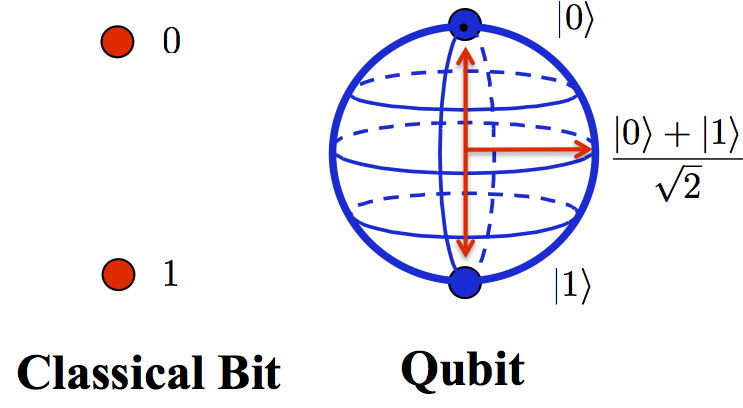
Qubits leverage two uniquely quantum phenomena:
- Superposition – A qubit can exist as 0 and 1 at the same time
- Entanglement – Multiple qubits can be linked so that the state of one instantly affects the others
This means a quantum computer with N qubits can explore 2ⁿ possible states simultaneously, whereas a classical computer must check possibilities one after another.
The result?
Massive parallelism, but only for the right kinds of problems.
What Are Quantum Computers Made Of?
Unlike classical chips that operate comfortably at room temperature, quantum systems are extremely delicate.
Qubits are typically realized using:
- Superconducting circuits made from materials like niobium or aluminum on silicon chips
- Trapped ions, such as ytterbium or calcium atoms, are held in electromagnetic fields
- Photons, using light particles for information transfer
- Topological materials, including exotic states like Majorana fermions in nanowires
Most of these systems must be cooled to near absolute zero to reduce noise and maintain quantum coherence. This extreme requirement highlights why quantum computing is still largely confined to research labs and specialized data centers.
Where Quantum Computers Truly Excel
Quantum computers will not replace classical computers; rather, they complement them.
Their real strength lies in solving problems that are practically impossible for classical machines, such as:
- Factoring extremely large numbers, a task central to modern cryptography
- Simulating molecules and chemical reactions at the quantum level
- Exploring vast solution spaces where possibilities grow exponentially
For example, algorithms like Shor’s show that problems taking classical computers years or centuries could, in theory, be solved by quantum machines in minutes.
This is why organizations like IBM have invested heavily in building practical quantum systems and making them accessible via the cloud.
Industries Poised for Disruption
Quantum computing is not a general-purpose tool—but for certain domains, it could be transformative:
- Optimization: logistics routing, portfolio optimization, supply chains
- Drug discovery: accurate molecular modeling to reduce trial-and-error
- Materials science: designing stronger, lighter, or more conductive materials
- Climate modeling: simulating complex systems with millions of interacting variables
- Cryptography: both breaking existing encryption and creating quantum-safe alternatives
According to insights from firms like McKinsey & Company, early commercial value will likely emerge in highly specialized, high-impact use cases rather than consumer applications.
The Quantum Computing & AI Overlap
One of the most exciting frontiers is the intersection of quantum computing and artificial intelligence.
Quantum computing can potentially:
- Speed up machine-learning training on massive datasets
- Improve optimization of neural networks
- Enhance generative models by identifying patterns faster
At the same time, AI is already helping quantum researchers by:
- Improving quantum error correction
- Optimizing qubit control and calibration
- Designing better quantum algorithms
Together, AI and quantum computing form a mutually reinforcing loop, especially powerful in areas like drug design and advanced materials research.
A Reality Check: Not Magic, Not Yet
Despite the hype, quantum computing is not a silver bullet.
Challenges remain:
- Qubits are fragile and error-prone
- Scaling systems beyond a few thousand qubits is extremely difficult
- Most real-world problems still don’t have efficient quantum algorithms
For the foreseeable future, quantum computers will act as specialized accelerators, working alongside classical systems rather than replacing them.
Conclusion:
Quantum computing represents a shift not just in technology, but in how we think about computation itself.
Its true value lies not in doing everything faster but in making the previously impossible finally approachable.
As research matures and hybrid quantum-classical models evolve, the question is no longer if quantum computing will matter but where it will matter first.
 Lateral Thinking
Leave a comment