
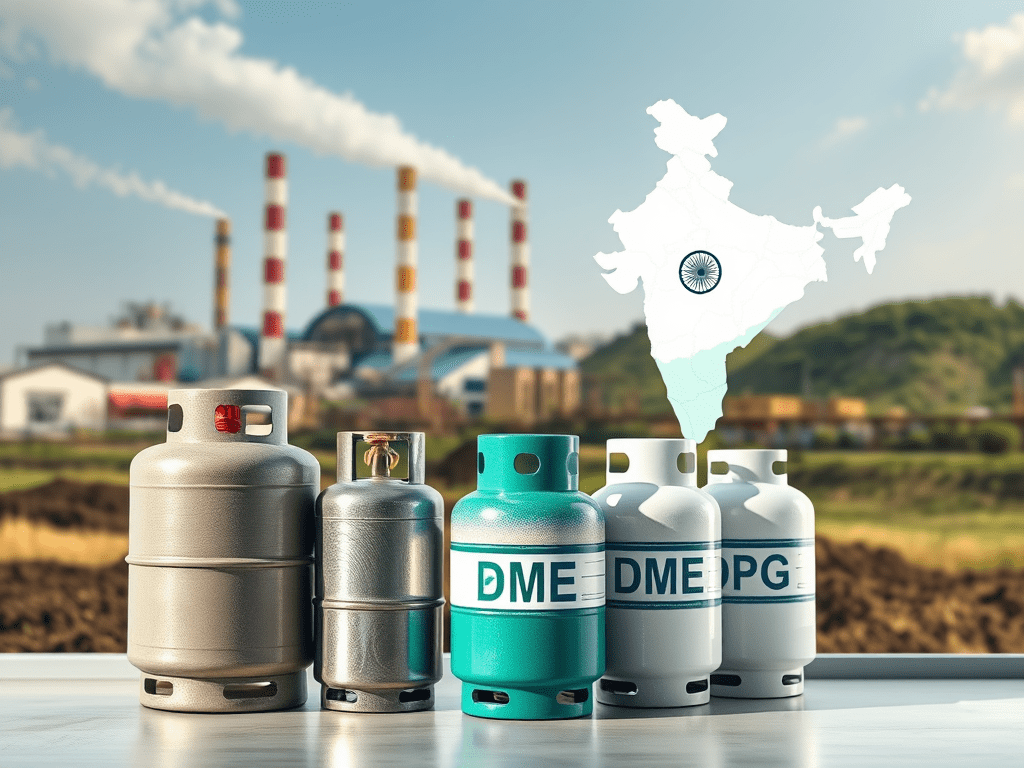
Introduction
India relies heavily on Liquefied Petroleum Gas (LPG) for cooking and household energy needs. However, a large portion of this LPG is imported, making the country vulnerable to global price fluctuations and geopolitical risks. This has sparked interest in alternative fuels that can be produced domestically.
One such alternative is Dimethyl Ether (DME), a clean-burning fuel that shares several properties with LPG and can potentially substitute it partially or fully.
Let us look at how DME compares with LPG and whether it can realistically reduce India’s dependence on imports.
Understanding India’s LPG Dependence
India consumes roughly 27-28 million tonnes of LPG annually, and about 66% of this demand is met through imports. This means around 18 million tonnes of LPG are imported every year.
Most of these imports come from the Middle East, although India has recently signed deals to diversify supply. For instance, a 2026 agreement with the United States will supply around 2.2 million tonnes per year, accounting for roughly 10% of India’s LPG imports.
At an estimated landed cost of around ₹60 per kg, the country’s LPG import bill crosses ₹1 lakh crore annually. Any disruption in global supply chains or geopolitical tensions can therefore impact both prices and energy security.
This dependence is one of the key reasons why India is exploring domestic alternatives like DME.
What is Dimethyl Ether (DME)?
Dimethyl Ether is a clean-burning fuel that can be produced from various feedstocks such as:
- Coal
- Natural gas
- Biomass
- Methanol
It behaves similarly to LPG when stored under pressure and can be transported in cylinders. Because of this similarity, DME can be blended with LPG or potentially replace it with limited infrastructure changes.
India’s policy discussions currently allow up to 20% DME blending in LPG, while 8% blending can be achieved without major changes to existing infrastructure.
Manufacturing Pathways for DME
1] Coal-to-DME
India has abundant coal reserves, making coal-based DME production attractive from an energy security perspective.
Large-scale projects have been proposed in which coal is converted into synthesis gas and then into DME through chemical processes.
For example, one proposed project in Gujarat plans to use around 35 million tonnes of coal annually to produce 6–7 million tonnes of DME.
Key points:
- Can replace 8–20% of India’s LPG imports
- Large plants require significant capital investment (~$10–15 billion)
- A smaller 210,000 tonne plant may achieve ~24% IRR with a 4–5 year payback
- Substituting 8% of LPG imports could save about ₹9,500 crore annually in foreign exchange
However, coal-based DME has an important drawback: high upstream carbon emissions from coal gasification.
2] Biomass-to-DME
Another route is to produce DME from biomass or agricultural waste, often via an intermediate step involving methanol.
Indian institutions such as CSIR-NCL are developing technologies to produce renewable DME (rDME) using agricultural residues.
Key points:
- Smaller plants with lower capital requirements (~$1–2 billion for large facilities)
- Potential to produce 1–2 million tonnes annually initially
- Can create rural jobs by utilizing agricultural waste
- Competitive with LPG if priced around ₹50–70 per kg
This pathway also aligns better with India’s bioeconomy and rural development goals.
Transportation and Infrastructure
One reason DME is gaining attention is its compatibility with existing LPG infrastructure.
Similarities include:
- Both are stored as liquefied gases under moderate pressure
- Both can be transported in pressurized cylinders or tankers
- Existing LPG distribution systems can be adapted for low-level blending
However, pure DME has different material compatibility and lubrication properties, meaning:
- Some seals and components may need modification
- Blending limits may apply initially
Despite this, the transition cost is still much lower than building a completely new fuel distribution network.
Calorific Value Comparison
Energy content plays an important role in determining fuel efficiency.
| Fuel | Approx. Calorific Value |
|---|---|
| LPG | ~46–50 MJ/kg |
| DME | ~28–30 MJ/kg |
As DME has a lower energy density, a larger quantity is required to deliver the same amount of energy as LPG.
However, DME burns very cleanly, producing:
- Almost no soot
- Lower particulate emissions
- Reduced NOx emissions in some applications
This makes it attractive for both household fuel and transportation applications.
Economic Comparison (Rough Estimates)
Below is a simplified comparison of the energy equivalent to 1 million tonnes per year.
| Aspect | Imported LPG | Coal-to-DME | Biomass-to-DME |
|---|---|---|---|
| Annual Cost | ~₹10,800 crore | ~₹7,000–8,000 crore | ~₹6,000–9,000 crore |
| Capital Investment | Not required (existing supply chain) | $10–15 billion | $1–3 billion |
| Forex Impact | High import dependence | Major forex savings | Forex savings + rural economic benefits |
| Payback Period | Not applicable | ~3–5 years | ~4–6 years |
Coal-based DME offers scale and energy security, while biomass-based DME offers better sustainability.
Carbon Emissions Comparison
Lifecycle emissions vary significantly depending on how the fuel is produced.
| Fuel Type | Approx Lifecycle Emissions |
|---|---|
| Imported LPG | ~1–1.5 Mt CO₂ per energy equivalent |
| Coal-based DME | ~2.5–4 Mt CO₂ |
| Biomass-based DME | ~0.2–0.5 Mt CO₂ |
Coal-derived DME can actually have higher lifecycle emissions than LPG, unless carbon capture technologies are used.
Biomass-derived DME, on the other hand, can reduce greenhouse gas emissions by 70–90% compared to fossil LPG.
Opportunities for India
If developed properly, DME can offer several benefits:
- Reduced LPG imports
- Improved energy security
- Utilization of domestic coal and biomass
- Lower household air pollution
- New rural economic opportunities through biomass supply chains
Challenges to Address
Despite the potential, a few issues remain:
- High capital cost for coal-based plants
- Lower energy density compared to LPG
- Infrastructure adjustments for higher blending levels
- Environmental concerns around coal-based production
Policy clarity and pilot projects will be crucial in determining whether DME becomes a mainstream fuel.
The Way Forward
Dimethyl Ether is not a perfect replacement for LPG, but it can become a strategic supplementary fuel for India.
A balanced approach may involve:
- Short-term blending of DME with LPG
- Coal-based DME for large-scale energy security
- Biomass-based DME for sustainable rural energy systems
If implemented carefully, DME could reduce India’s import dependence while supporting both energy security and climate goals.
Further Read
- India Inks Historic US LPG Deal to Import 2.2 MTPA in 2026 – Energetica India
- In ‘Historic First’ Deal, India to Source 10% LPG Imports from US – Indian Express
- How Dependent is India on Imported LPG? – India Today Data Intelligence Unit
- Dimethyl Ether Emerges as Clean Indigenous Alternative to LPG – Hindustan Times
- Pre-Feasibility Report for Dimethyl Ether (DME) – NITI Aayog
- Techno-Economic Analysis of DME Production – UMRI Journal of Science & Technology
- Life Cycle Greenhouse Gas Impacts of Coal and Gas-Based Energy – PubMed
- Life Cycle GHG Impacts of Coal and Gas-Based Power Generation – Council on Energy, Environment and Water
- Indian Scientists Pioneer DME Technology to Replace LPG – Rediff Business
- Can Coal-Derived DME Reduce Dependence on LPG? – Walisongo Chemical Education Journal
 Lateral Thinking
Leave a comment