
Introduction
For years, HDFC Bank has been seen as one of the most stable and consistent performers in the Indian banking space.
But 2026 has been different.
The stock has been under pressure, investor confidence has been shaken, and questions are being raised, not about survival, but about near-term growth and execution.
Let us break this down.
What Happened Recently?
The latest trigger came on March 18, 2026.
- Atanu Chakraborty (part-time chairman) resigned
- His resignation cited “certain happenings and practices” not aligning with his values
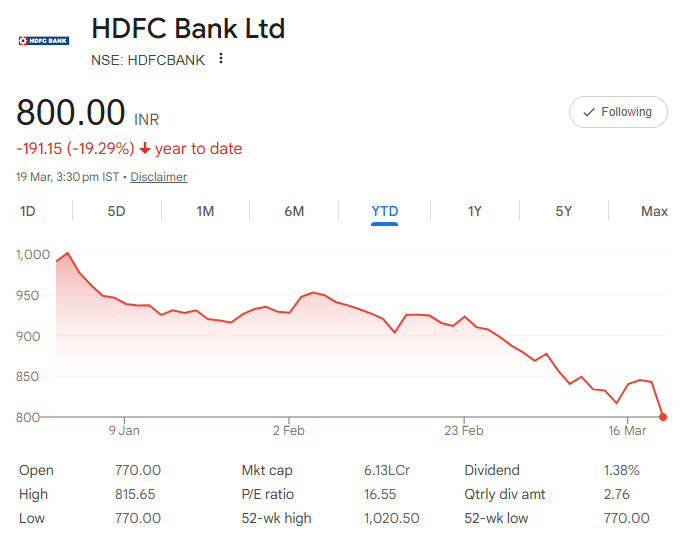
- The market reacted sharply:
- ~9% intraday fall
- Over ₹1 lakh crore erosion in market cap
Even though:
- The bank clarified that there are no governance issues
- The RBI supported the bank’s position
Is this development a one-off or Part of a string of Events?
The resignation is just the latest event. The pressure has been building for a while due to the underlying concerns:
- Stock performance
- Down ~20% from peak (~₹1,020 in Oct 2025)
- Weak returns over the last 6 months
- Loan-to-Deposit Ratio (LDR)
- Currently ~99%
- Ideal range: <90%
- Indicates deposit growth is not keeping pace with lending
- Deposit mobilisation challenge
- Increasing competition for deposits
- Higher cost of funds
The bank is lending well, but struggling to fund that growth efficiently
The Merger Hangover (HDFC Ltd + HDFC Bank)
To understand today’s issues, we need to go back to 2022, when HDFC Ltd merged with HDFC Bank
What changed post-merger?
- Home loans jumped from ~6% → ~25% of the loan book
- Retail exposure increased significantly
- Scale increased, but so did complexity
Impact:
- Margins (NIMs) compressed
- Asset quality metrics saw temporary pressure
- Deposit requirements surged
The merger created a stronger bank in the long term, but in the short term, it stretched balance sheet dynamics
Who Owns HDFC Bank? Why It Matters
HDFC Bank is not just another stock but a widely held stock across institutions and funds.
Shareholding snapshot:
- FIIs: ~47.7%
- Mutual Funds: ~26.7%
- Other DIIs (LIC, etc.): ~10.5%
- Retail investors: Remaining
Key institutional names:
- SBI Mutual Fund
- HDFC Asset Management Company
- UTI Mutual Fund
- ICICI Prudential Mutual Fund
- Global players like JPMorgan and BlackRock
How This Impacts Retail Investors
Even if you do not directly own HDFC Bank stock, chances are, as a retail investor, you are still exposed
Why?
- HDFC Bank has a heavyweight in indices like Nifty Bank
- It is a top holding in most mutual funds
What happens when the stock falls?
- Mutual fund NAVs take a hit
- Banking indices fall
- Portfolio returns decline, even for passive index investors (Recent fall in HDFC Bank dragged Bank Nifty significantly, impacting diversified portfolios)
Is the Business Actually Weak?
Despite stock pressure, fundamentals are still strong:
- Profit (TTM): ~₹77,000+ crore
- Gross NPA: ~1.2–1.4% (controlled)
- Loan growth: ~12% YoY
- Deposit growth: ~11–12% YoY
To summarize, the issue is the nuance of balance and execution
What Should Investors Watch For Next?
Key triggers going forward:
1. Deposit Growth
- Can the bank bring LDR back below 90%?
- This is the single biggest monitorable
2. Margin Recovery
- Improvement in NIMs through better deposit pricing
3. Management Stability
- Post-resignation clarity and leadership confidence
4. Quarterly Updates (Q4 FY26)
- Will give direction on:
- Deposit traction
- Growth sustainability
Short-Term vs Long-Term View
Short-term:
- Volatility likely to continue
- Sentiment-driven movements
- Key levels around ₹800 are critical
Long-term:
- Strong franchise
- Deep retail presence
- Consistent profitability track record
If execution improves, the bank can regain market confidence
Conclusion
HDFC Bank is not facing a crisis—it is facing a transition phase.
- A large merger
- Balance sheet adjustments
- Leadership noise
- Market expectations catching up
For investors, the key is to separate Noise from Fundamentals
 Lateral Thinking
Leave a comment