
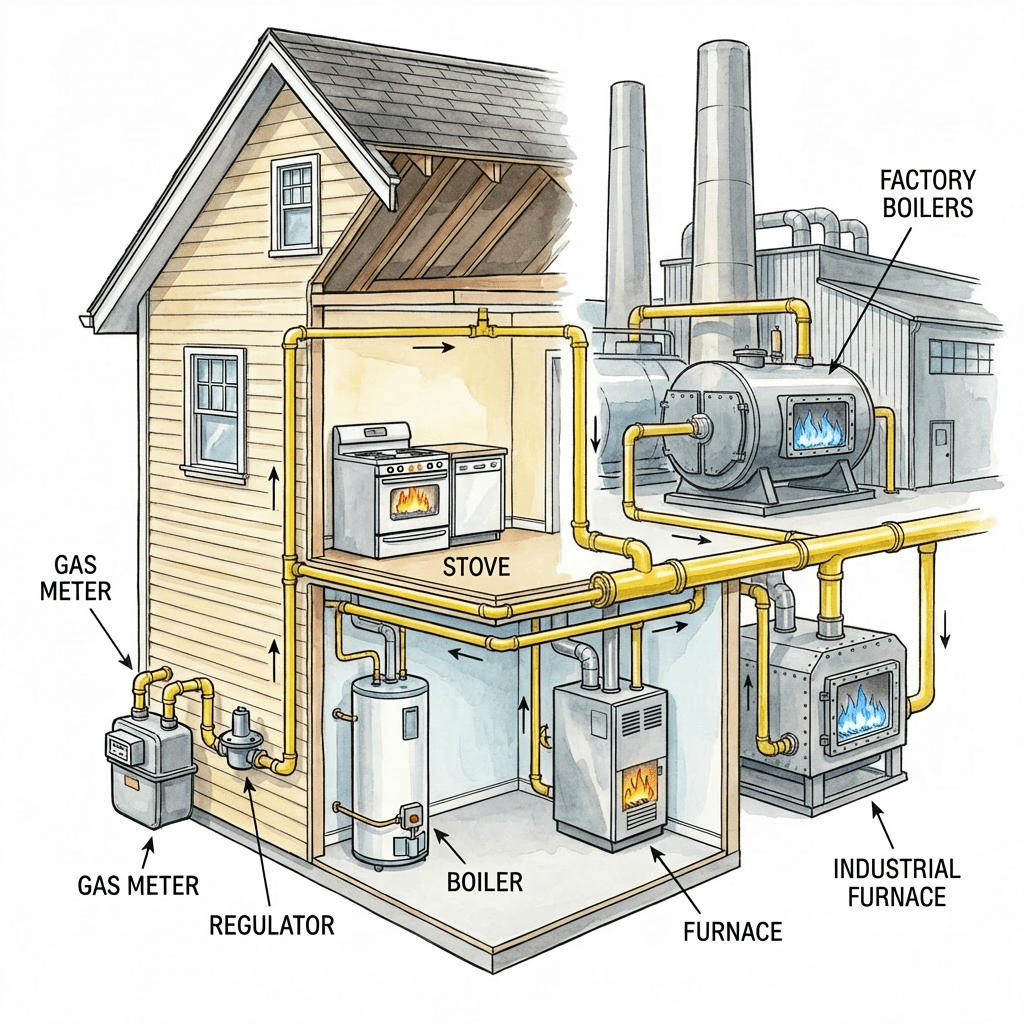
Introduction
Piped Natural Gas (PNG) is steadily becoming a preferred cooking and heating fuel in urban India. With increasing focus on cleaner energy and convenience, PNG is being promoted as an alternative to LPG cylinders, especially in cities with expanding pipeline networks. (The Times of India)
What is PNG
PNG is natural gas (primarily methane) supplied directly to homes and industries through underground pipelines. Unlike LPG, which is stored in cylinders, PNG is delivered continuously, eliminating the need for storage and manual handling. (IOAGPL)
How it is Derived / Extracted / Produced
PNG originates from natural gas extracted from underground reservoirs (onshore or offshore). The process involves:
- Exploration & drilling of gas fields
- Processing to remove impurities (water, CO₂, sulfur compounds)
- Compression & transportation via pipelines or LNG conversion for long-distance movement
- Distribution through city gas networks to households and industries
Natural gas is largely composed of methane and is considered a relatively cleaner fossil fuel compared to coal or oil. (IOAGPL)
Why is it used
PNG adoption is increasing due to:
- Convenience: Continuous supply—no refilling or cylinder replacement
- Safety: Being lighter than air, it disperses quickly in case of leaks
- Cost efficiency: Generally cheaper and billed based on usage (think-gas.com)
- Cleaner combustion: Lower emissions compared to LPG and other fossil fuels
- Reliability: Less disruption compared to cylinder-based supply chains (The Times of India)
Challenges with PNG
Despite its advantages, PNG has limitations:
- Infrastructure dependency: Requires pipeline networks; limited reach in smaller towns
- High initial setup cost: Pipeline installation and connection charges
- Lower calorific value: Produces less heat per unit compared to LPG (pngrb.gov.in)
- Import dependency: India still imports a significant portion of natural gas (including LNG) (Wikipedia)
- Scaling constraints: Expansion depends on regulatory approvals and urban planning challenges
PNG vs LPG – Key Comparison
| Parameter | PNG | LPG |
|---|---|---|
| Calorific Value | ~8,500–9,500 kcal/scm (lower) (LinkedIn) | ~10,800–11,500 kcal/kg (higher) (LinkedIn) |
| Storage & Transportation | No storage; piped supply | Requires cylinders, storage, logistics |
| Cost | Generally cheaper, pay-as-you-use (think-gas.com) | Higher due to cylinder and logistics costs |
| Scaling Complications | Requires pipeline infrastructure; slow expansion | Easily scalable via cylinder distribution |
| Import Dependency (India) | ~50–56% (via LNG imports) (Wikipedia) | ~55–60% import dependent (Wikipedia) |
Conclusion
PNG represents a shift toward cleaner, safer, and more convenient urban energy consumption. Its success depends heavily on infrastructure expansion and policy support.
While LPG remains dominant due to accessibility, PNG is gradually emerging as a long-term, sustainable alternative, especially in urban India.
 Lateral Thinking
Leave a comment