
Introduction
Compressed Biogas (CBG) has emerged as a promising renewable fuel in India’s push toward energy security and sustainability. Despite its strong environmental credentials and government backing, it has not yet replaced conventional fuels like LPG, CNG, or PNG at scale.
What is CBG?
CBG (also called Bio-CNG) is a purified form of biogas with high methane content (90%+), making it chemically similar to natural gas. It is compressed and can be used in vehicles, industries, and households, just like CNG or PNG. (Bharat Petroleum)
How it is Produced
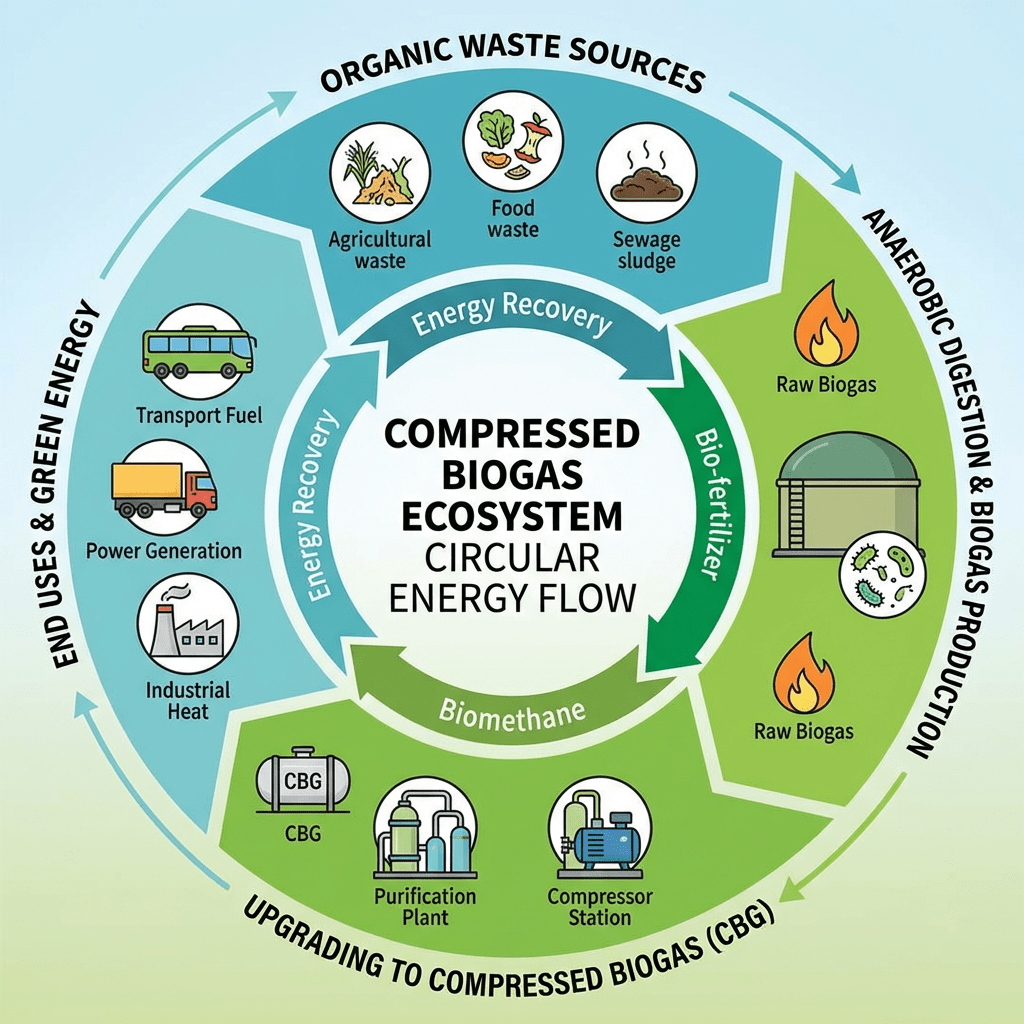
CBG is derived from organic waste such as agricultural residue, cattle dung, municipal waste, and sewage.
The process involves:
- Anaerobic digestion of biomass (oxygen-free decomposition)
- Production of raw biogas (55–65% methane)
- Purification to remove CO₂, H₂S, and moisture
- Compression into CBG for storage and transport (Biogas MNRE)
Why is it used
CBG offers multiple benefits:
- Renewable & sustainable (waste-to-energy model)
- Lower emissions compared to fossil fuels
- Helps manage agricultural and urban waste
- Reduces dependence on imported fuels (The Anaerobic Digestion & Biogas Blog)
It also has calorific value comparable to CNG, making it technically a viable substitute. (IOCL)
Why CBG Has Not Replaced CNG, LPG, or PNG
Despite its potential, several challenges limit adoption:
- Infrastructure Gap
CNG/PNG networks are already well-established, while CBG plants and supply chains are still nascent. - Scaling Challenges
India’s CBG potential is high, but current capacity is less than 1% of potential, showing slow scale-up. (CEEW) - Feedstock & Logistics Issues
Collection, segregation, and transport of biomass are complex and inconsistent. - Economic Viability
CBG pricing (~85% of CNG) often makes projects financially unattractive without subsidies. (REGlobal) - Social & Regulatory Barriers
Local resistance and delays in plant approvals slow deployment. (The Times of India) - Energy Density vs LPG
LPG has significantly higher energy per volume, making it more efficient for cooking. (About I-Maximum Company)
Comparison Table: CBG vs Other Fuels
| Parameter | CBG | CNG | LPG | PNG |
|---|---|---|---|---|
| Calorific Value | Similar to CNG (~52 MJ/kg) | High (~similar to CBG) | Very high (≈2× natural gas per volume) | Same as CNG |
| Storage & Transport | Requires compression & cylinders | Mature infrastructure | Easy cylinder storage | Pipeline-dependent |
| Cost | Slightly lower than CNG but subsidy-driven | Market-driven | Subsidized for households | Competitive in cities |
| Scaling Challenges | High (feedstock + infra) | Low (established) | Low (mature supply chain) | Medium (pipeline expansion) |
| Import Dependency (India) | Low (domestic waste-based) | Moderate–high | High (import-heavy) | High (linked to natural gas imports) |
Conclusion
CBG is technically capable but practically constrained. While it holds strong long-term promise as a circular, domestic fuel, its adoption is limited by infrastructure, economics, and execution challenges.
In the near term, CBG will likely complement, not replace, CNG, LPG, and PNG, unless scaling bottlenecks are systematically addressed.
 Lateral Thinking
Leave a comment