Introduction
For years, Indraprastha Gas Ltd (IGL) has been the undisputed king of Delhi’s roads, fueling the city’s transition from diesel to CNG. However, the Delhi EV Policy 2.0 (2024–2030) has introduced a structural shift that investors can no longer ignore. As the city mandates a “Green-only” future, IGL’s core business model is facing its most significant test yet.
Policy Overview
Delhi’s EV Policy 2.0 is designed to ensure that 25% of all new vehicle registrations are electric by 2025, with targets scaling up to more aggressive levels by 2030. The policy uses a combination of hefty subsidies, road tax waivers, and, most critically for IGL, registration bans on new internal combustion engine (ICE) vehicles, including CNG variants, in specific commercial segments.
Impact on Earnings: 2W, 3W, and 4W
- Two-Wheelers (2W): While IGL never had a major stake in 2W, the ban on new petrol/CNG 2W registrations starting April 2028 signals the government’s uncompromising stance on electrification.
- Three-Wheelers (3W): This is a critical hit. From January 2027, only electric autos will be registered. Currently, a massive portion of IGL’s retail CNG volume comes from the auto-rickshaw fleet. A phased-out 3W CNG fleet directly threatens roughly 15-20% of IGL’s recurring daily gas sales.
- Four-Wheelers (4W) & Buses: The DTC has already begun withdrawing CNG buses, with volumes expected to fall to near zero in 2026. For private cars, while CNG remains a popular bridge, the lack of incentives compared to the ₹1 lakh scrappage bonus for EVs is slowing new conversion rates.
Pros & Cons for Investors
Pros:
- PNG Stability: IGL’s Piped Natural Gas (Household/Industrial) remains a solid, unaffected revenue stream (approx. 25-30% of volumes).
- New Geographies: Growth in “New GAs” (Geographical Areas) outside Delhi is offsetting the capital’s volume loss.
Cons:
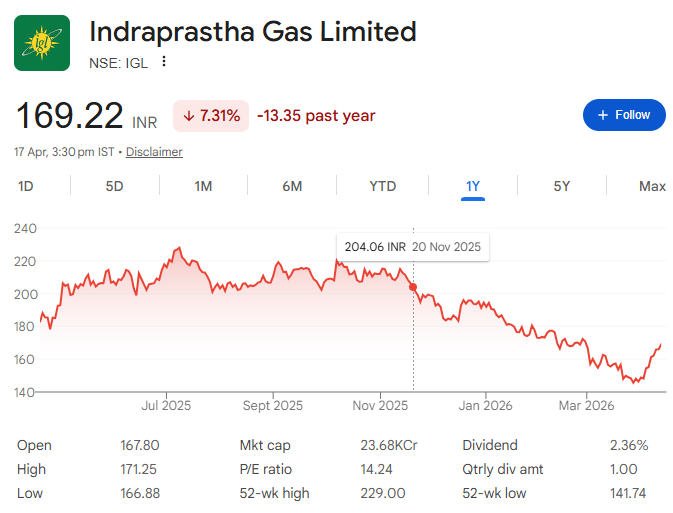
- Multiple Compression: The stock, currently trading around ₹390 (April 2026), has seen its P/E multiple shrink as markets price in “terminal value” risks.
- Volume Stagnation: The loss of high-volume DTC and auto-rickshaw clients creates a “growth ceiling” that is hard to pierce within Delhi NCR.
Summary
For investors, IGL is transitioning from a high-growth “Moat” stock to a Value/Dividend play.
While the company is aggressively expanding into new cities and exploring its own EV charging hubs, the Delhi EV policy serves as a constant headwind for the stock price.
Expect volatility as the 2027-2028 registration deadlines approach.
This video discusses the immediate market reaction and the pressure on IGL shares following the Delhi government’s announcement to phase out CNG-driven vehicles.
 Lateral Thinking
Leave a comment