Introduction
The biggest question around EPS recycling in India is not whether thermocol can be recycled. It can. The question is whether the economics work after collection, transportation, processing and selling the recovered material are accounted for.
The answer is: yes, but only under the right conditions.
The Economics Start With Density
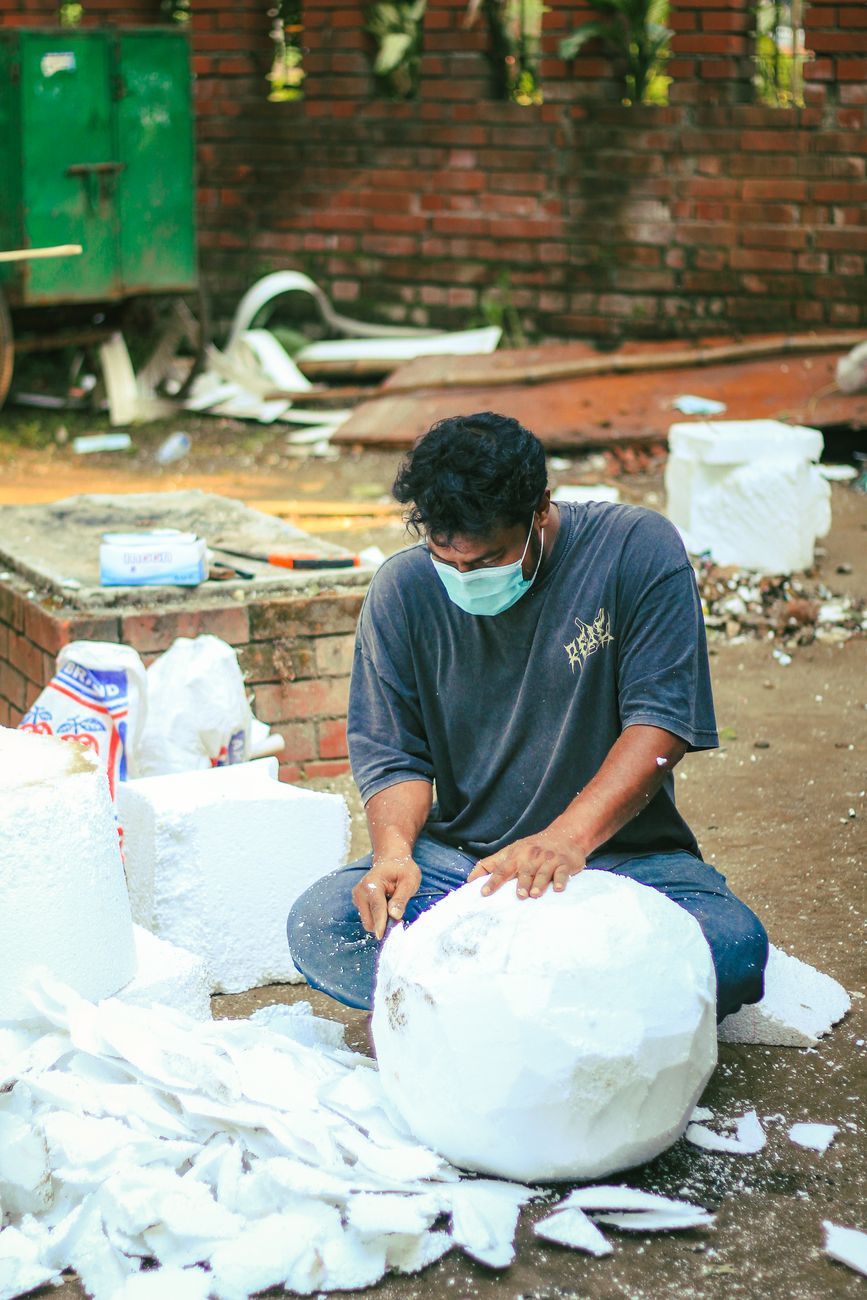
EPS can contain approximately 98% air. A recycler collecting loose thermocol therefore spends money transporting enormous volumes of material containing relatively little polymer.
Densification changes the equation.
A recent industrial study reported an overall yield of approximately 78% from post-consumer EPS to densified polystyrene and energy consumption of around 0.26 kWh/kg of incoming EPS.
This means electricity is not necessarily the biggest cost. Collection and logistics are.
Where Does the Business Become Attractive?
Consider three broad sourcing situations.
Industrial EPS waste:
Waste generated by appliance manufacturers, packaging companies, automotive companies or large warehouses can be concentrated and relatively clean. Collection costs can therefore be low, making densification highly attractive.
Organised commercial collection:
EPS collected from markets, institutions and MRFs can also work if sufficient volumes are available within a reasonable radius.
Household collection:
This is considerably more difficult. Small quantities dispersed across a city create high transportation and sorting costs, potentially eliminating the value created through recycling.
What Is the Value of the Output?
Indicative Indian market listings show that loose EPS can trade at roughly ₹20–55/kg, while densified EPS/lumps and recycled PS granules can command higher prices depending on quality and buyer requirements.
However, the important point is that densification does not necessarily create a huge polymer-value premium.
Its biggest economic benefit is that it removes the cost of transporting air.
The Most Viable Business Model
The strongest model is therefore:
Large waste generator → Local collection → Sorting → Densification → Assured offtake (Critical)
A recycler should ideally identify the buyer before purchasing the machine.
For MRFs, a 50–100 kg/hour machine can potentially be sufficient if the facility has reliable EPS volumes. Larger 200–500 kg/hour systems make more sense for industrial generators or dedicated regional processing hubs.
Going directly into granulation or chemical recycling adds capital expenditure and process complexity. It should be considered only after sufficient volumes, and an assured market have been established.
What Should India Do Next?
The opportunity is not to build one giant EPS recycling plant and transport thermocol across the country.
A better model is distributed densification: place relatively low-cost machines near large sources of EPS, convert the waste into dense PS, and transport the compact output to larger processors.
The fundamental business proposition is therefore straightforward:
Don’t recycle air. Remove the air first — and then recycle the polymer.


Leave a Reply